|
| Mary and Joseph searching for lodging |
About 25 kilometers south
of Manila, in the town of Kawit in Cavite, the streets were almost empty and
the quiet were intermittently broken by marching bands, which gathered one by
one at the old Saint Mary Magdalene Parish Church and had come already
performing.
Just before dusk, a few
blocks away, at the Freedom Park, the cluster of makeshift food stalls and tiangge had all opened, and people were
strolling around, meeting up, chattering, eating and playing around the
monument of the town’s most famous son, General Emilio Aguinaldo, the first
president of the First Republic of the Philippines. The park nestles in the
shadows of the Aguinaldo Shrine, the handsome ancestral mansion of Aguinaldo, first
built in 1845 and reconstructed in 1849, where he declared the independence of
the Philippines on June 12, 1898. Yearly, Kawit figures prominently in the
celebration of the Independence Day, a most significant commemoration in the
nation. But Christmas is a more festive occasion, bringing people together and lovely
memories, and in Kawit the Christmas Eve celebration can be grand.
As the dark settled, the predominantly-white
Aguinaldo Shrine was bathed in the brightest of colors, changing to the
accompaniment of Christmas music. People gathered to watch and at the same time
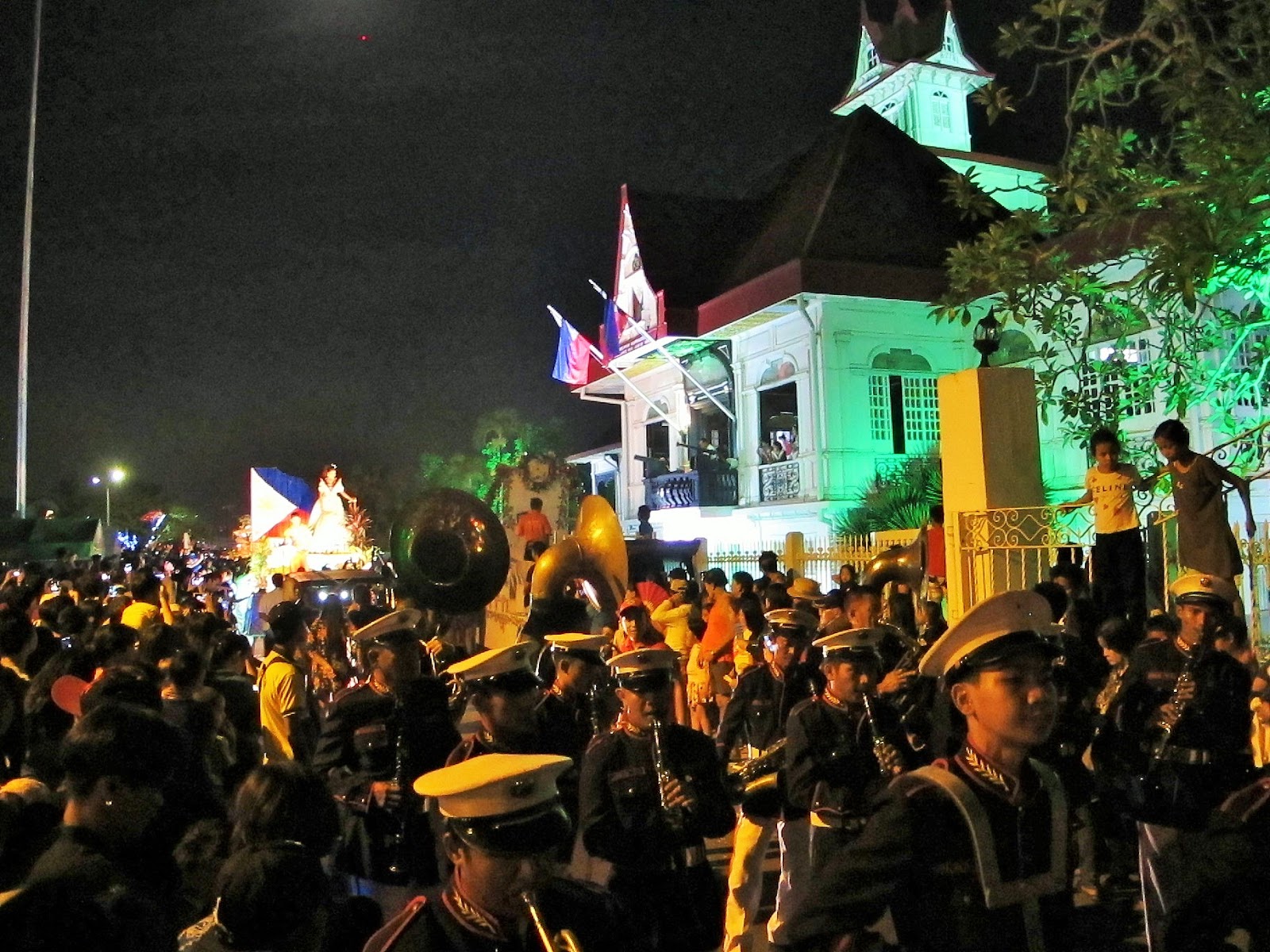
waited for the traditional float parade to pass by. Kawiteños celebrate Christmas Eve with the panunuluyan, and their version of the panunuluyan, called maytinis,
differ from all else in the country by, for one, showiness.
The floats they were
anticipating had gathered in Binakayan Kanluran. The barangay is near an area often called Junction, where traffic is
usually busy being a main thoroughfare of cars going to Metro Manila and to
other parts Cavite, and a makeshift amusement park, the perya, had been set up at one corner for the season.
At the Aguinaldo Shrine and
on the main street, the crowds had become thicker, their eyes fixed on a bright
moving spot at the end of the street. The parade had started, and the crowds
became restless as it neared the shrine. Marshalls on motorcycles asked the
spectators to give way, followed by men in gorilla and monster costumes,
scaring and amusing the crowd, taking place of the payaso or clowns of yesteryears.
The floats came, one after
another, richly decorated and bearing persons playing Biblical characters. Pulled
by small vans and jeeps and brightly lit to show the costumes and sets, they
depicted select scenes and characters from the Bible—from Adam and Eve of the
Old Testament to the announcement of Jesus Christ’s birth in the New Testament.
Each float was followed by a band of children called pastores, literally “shepherds,” costumed accordingly. Marching
bands from all over the province were placed in between, playing Christmas
tunes.
The floats made a brief stopped
at the shrine, where from the balcony a person read the stories and meanings of
each float; and proceeded to go around parts of the town, ending at the church.
Along the way, the parade got stalled and slowed down by crowds getting too
near them, and by the float of Mary and Joseph, the most important, reenacting
the search for lodging—stopping by three to four houses, asking for a place to
stay and being turned away by the innkeepers, their exchanges all chanted with
music from a marching band.
The origin of this fusion
of pageantry and religious dramatization is unknown, but locals generally
believe that the maytinis has been
practiced for about three centuries now, starting with the establishment of the
Saint Mary Magdalene Church, promulgated by Spanish missionaries stationed
there to celebrate Christmas as well as to employ an effective way of
evangelization.
Christianization
of the Philippines started with the first European contact and then colonization
in the sixteenth century, resulting in the predominance of Christianity,
particularly Catholicism, in the country with about ninety percent of the
present population professing to be Christians.
The
spread of Christianity in Cavite started in a settlement now known as Kawit,
being the first anchorage of the Spaniards in the province. It was then given
the name Cavite el Viejo and was changed to Kawit in 1907. Franciscan friars
are said to be the first missionaries to administer Kawit, and these included
Spanish friar Pedro Bautista or Peter Baptist Blasquez, who came to the
Philippines in 1583 after being in Mexico. He spent nine years in the Spanish
colony, where he built a hospital in 1591 in the seaport in Cavite, most
likely, Kawit. He was then sent to Japan, where he was crucified with twenty-six
others. They would eventually be known as the Martyrs of Japan, canonized as
saints in 1862.
In 1624, Manila Archbishop
Miguel Garcia Serrano commended Cavite el Viejo to the supervision of the
Jesuits, who established the parish with Saint Maria Magdalena as patron saint,
chosen, as anecdotes tell, because the seaport area had become known for
prostitution. The Jesuits also built the first church, which was made of wood,
in 1638 with the help of six Filipino families from the towns of Silang and
Maragondon. The present stone church was built in 1737. They Jesuits administered
the parish until 1768, after which the secular clergy took over. Then the
church was place under the Recollects in 1849.
Along the way, most likely
in the early years of Kawit’s Christianization, Christian celebrations, such as
Christmas, were also brought in, and the celebrations were also made avenues
for Christian education of the locals, employing different mediums that have
become part of local culture.
“Spanish colonization brought with it, along
with all the other cultural changes, Spanish drama forms. The earliest to
establish itself was the religious drama, an obvious and powerful way to teach
religion, being aural, visual, and participatory,” wrote the late food writer,
cultural researcher and professor Doreen G. Fernandez in her book Palabas: Essays on Philippine Theater
History (Ateneo de Manila University Press, Quezon City, 1996). “Soon, the
Filipino’s year came to follow the liturgical calendar, marked by osana, sinakulo, salubong, and the like
at Holy Week; in May by santakrusan
and tibag to celebrate the finding of
the Holy Cross, and Flores de Mayo and other similar observances to honor the
feasts or attributes of Mary; by pangangaluluwa
on All Souls’ Day in November; and by panunuluyan
and pastores and tatlong hari at Christmastime; and by various other dramas and
dramatizations designed by parish priests and their assistants or by the
fertile folk imagination.”
Fernandez classified these religious
dramatizations into two, according to length: The full-length dramas that
include the sinakulo, and the short
dramatizations like the salubong and panunuluyan.
The panunuluyan (literally, “search for shelter”), also called panuluyan, pananawagan and pananapatan, is most known to be held by
the Tagalogs of Central and Southern Luzon but in recent years has mostly
vanished, especially in urbanized communities. Several parts of the Bicol
Region in southeastern Luzon Island have a similar practice called kagharong or kagharong-harong.
“The Panunuluyan is the Philippine version of a Mexican Christmas
tradition that dates back to the 16th century,” explained writer Alejandro R.
Roces in “Panunuluyan: A Mexican
Christmas in the Philippines,” part of his column “Roses and Thorns” in The Philippine Star (December, 18,
2007). “The las posadas, meaning ‘the
inns,’ was first conceived by St. John of the Cross in 1580 as a processional
version of the Holy Family’s journey to Bethlehem and subsequent search for
lodging. Seven years later it was introduced in Mexico by Roman Catholic
missionaries. From there, it rapidly spread through Latin America, and even to
the Philippines via the galleon trade.”
The
Mexican tradition is held for nine nights. “A candle-lit procession of
neighborhood children and adults will journey to three pre-selected homes (representing
inns) seeking shelter for Joseph and Mary,” Roces described. “The Holy Couple
is usually represented by either two small statues or children. At the first
two homes, the heartfelt request of Joseph for shelter is rejected; but at the
third home the request is accepted, the doors to the home are flung open and
the pilgrims are greeted by a table laid out with traditional Christmas fare. A
communal celebration ensues, including a star-shaped piñata for the children
and a hot beverage called ponche for
adults. Each night this ritual is performed with the procession ending in
different homes. On the ninth night, or noche
buena, the pilgrims re-enact the birth of Christ in the final home.”
“In the Philippines, the Panunuluyan, meaning ‘looking for
lodging,’ is celebrated on Christmas Eve,” he further wrote. “To begin the
event, images of Mary and Joseph are wheeled from the church courtyard, usually
accompanied by two singers. They journey to three or four homes that represent
inns, sing their plight and request for shelter. The innkeepers, played by a
choir, inform them that the inn is full. In the end, the Holy Couple returns to
the Church for the Nativity and at the stroke of midnight appear at the altar
amid great rejoicing.”
Kawiteños have transformed this simple ritual into a spectacle that
is the maytinis. The origin of the name maytinis is also cannot be ascertained but it is assumed that it
came from the Latin matins, evening
prayers or nocturnal liturgy that ends at dawn. There are other Christmas Eve
traditions that are also called maytinis.
The maytinis of some towns and cities
of Pampanga—San Fernando, Magalang, Mabalacat and Mexico—consists of a
procession of images of saints, accompanied by colorful lanterns, some in the
shape of a fish, the symbol of Jesus Christ and singing choirs. The Kawit maytinis is different by having live
people on floats, instead of religious images on carrozas, performing and accompanying the panunuluyan reenactment.
The maytinis
is organized and overseen by the Confradia de Sagrada Familia in coordination
with the parish church. The religious lay organization chooses an Ama and an Ina (literally, “father and mother”) for the event, equivalent
to the hermano mayor and hermana mayor
of Philippine fiestas, who financially support and oversee the event.
In early December 2015, the Ama and Ina of the maytinis of the previous year bade farewell
and new ones were proclaimed, most likely, signaling the start of the Christmas
season in Kawit. Like the rest of the country, the Misa de Gallo (literally, Mass of the Rooster) or simbang gabi, the dawn masses, were
celebrated for nine days, from December 16 to 24.
On December 24, marching bands assembled by the
church by two in the afternoon, rehearsing and doing exhibitions before parading
around the town. This signalled the start of the maytinis the way the diana
signals the start of a fiesta celebration in some parts of the Philippines.
By four, the floats were assembled in Binakayan
Kanluran. Usually, the float parade starts at the church, with Liturgy of the
Word and readings from the Bible officiated by the parish priest, but sometimes
it also starts at the resident barangay
of the current Ama or Ina. An hour later, the bands and the pastores gathered in Marulas. As the sun
began to set, streaking the sky with vermillion and tangerine, the maytinis procession readied itself and began
at seven in the evening. From Binakayan Kanluran, it went to Marulas, Kaingen,
Wakas, Poblacion and the church.
There were sixteen floats for this year, each one sponsored and created by the town’s barangays, civic organizations or
private companies. A barangay can be
designated the same float for several years.
As a whole, the floats depict the Christian
salvation history starting from the commission of the Original Sin by Adam and
Eve to the birth of Jesus Christ, who is promised to save mankind from sin.
At the head of the parade
was surprisingly a non-religious float called “Inang Pilipinas” (Mother Philippines), which in previous years concluded
the parade, an obviously recent and local addition. This emphasized the fact
that the Philippines is the only predominantly Catholic nation in Asia, which
is interpreted as having a special role in world salvation as expressed in its
slogan “Ang Pilipinas ang Diyos ang
pumili/Bansang Asya, kaligtasa’y ibahagi” (The Philippines God has
chosen/To Asia, salvation is imparted). This is the only non-Biblical float
this year. Other non-Biblical floats in maytinis
history included the EDSA People’s Power Revolution-inspired one in 1986.
The
following floats were inspired by the Bible, starting with “Adan at Eba” (Adam and Eve) with a fake
tree lade with shiny red apples, showing the temptation and the entry of sin.
“La Purisima Concepcion” (Conception Most Pure) told about the prophecy that a
virgin birth will save the world from sin. Other floats were “Si Noe at ang Baha” (Noah and the Flood), showing a small model on the ark atop a
mountain; Moises (Moses), holding the
tablets inscribed with the Ten Commandments; “Haring David (King David), with his wives; Haring Solomon (King Solomon); Si
Ruth at si Noemi (Ruth and Naomi), emphasizing respect for parents; “Samson at Delilah” (Samson and Delilah);
“Infanta Judith,” a Deuterocanonical character in gladiator dress and bearing
the severed head of Holofornes; “Reyna
Ester” (Queen Esther); “Pagbati”
(Annunciation), showing the angel Gabriel appearing to Mary; “Pagdalaw” (Visitation), enacting Mary’s
visit to cousin Elizabeth; “Panuluyan
(Search for Inn), with Mary riding a donkey and Joseph; “Pagbabalita ng Anghel (Tidings of the Angel), with an angel
appearing to kids dressed as shepherds and bearing a banner saying “Gloria in
Excelsis Deo” to announce the birth of Jesus Christ; and “Ang Pangako ng Diyos kay Zacarias” (God's Promise to Zacariah),with
an angel appearing to Zacariah to tell the news that he and his Elizabeth will
have a child.
Through the years, at least
in the recent years, the number of floats averages from fifteen to
seventeen. The exclusion and addition of floats are caused by a number of
factors—from float sponsors not able to meet deadline to the desire to add new
ideas. Additional
floats can be non-religious. In 1986, a float was included inspired by the EDSA
People Power revolution, which may have inspired the idea of having a fixed “patriotic”
float such as the “Inang Pilipinas.” The floats on Abraham and Amos were absent in 2015. Some floats also
changed the tableau of a character. The Moses float, for example, was
previously depicted as “Ang Pagliligtas sa Sangggol na si Moises”
(The Saving of Baby Moses) and the King David float was “David and Goliath.” In
this process, the parade has grown to be bigger.
Writer Marla Yotoko
Chorengel related in the book Pasko!: The
Philippine Christmas (National Bookstore and Anvil Publishing, Pasig City,
1998) that the traditional floats were “Talang
Maliwanag (Brilliant Star), Divina
Pastora (Divine Shepherdess), Siete
Archangeles (Seven Archangels) and Rosa
Mistica (Mystic Rose).”
“In the late ‘70s, these were eliminated and
replaced by Prophet Amos, Abraham, Infanta Judith and Queen Esther,” she wrote.
“Changes met with objections, resentment and controversy amongst the residents,
but in time, lectures and seminars on why the move was made enlightened the
people. Dissenters finally accepted the loss of the well-loved familiar images
and welcomed the new participants and their relevance to the present Maytinis.”
With the number of floats,
the designs of the floats and the costumes have of course changed, getting more
elaborate or showier to excite the people.
Being folk endeavors, the depictions
in the floats are not entirely historically accurate but stylized according to
folk sensibilities and popular culture, and thus riddled with anachronistic
elements. The tableaux are a curious melange of designs and motifs culled from
movies and illustrated books of Biblical stories, other folk dramatizations
such as the sinakulo, and the
people’s imagination and perception of a culture thousands of miles away and
thousands of years in the past.
Tableaux
of outdoors are filled with hills and mountains made of wood and paper, and
lots of potted plants, while the indoors have Grecian and Neoclassical pillars and
urns. The costumes also tend to be gaudy, especially on characters of royalty
such as Queen Esther and King Solomon, not far from the santacruzan, a popular parade about the finding of the True Cross
that has assumed the look of pageantry.
Often,
as much as the floats, the persons playing the roles of the Biblical characters
are also a source of spectacle. Traditionally, the players were picked from the
townspeople. While this is still done, picking the good-looking ones, the
organizers have also recently been getting models from the outside of the town.
More the noticeable are the attractive boys, who play Adam, angels and kings,
often in costumes that, in crafty ways show, their beauty. Often marginalized
in main church affairs, gay expressions manifest in events that blend show and
ceremony such as the maytinis and santacruzan, etc. and the more
“creative” aspect of church operations such as choir management, and dressing
and care of images. The eye-catching maytinis
players have become a continuous source of delight and, to others, a distraction
from the religiousness of the affair. While it is still overwhelming Hispanic-Filipino
religious in nature, the event has become interesting and even charming with
the blend of Filipino folk creative sensibilities and articulations of gay
desire.
While the parade was going
around the town, the church was in total dark, as if a theater readying for a
show, but already brimming with people. The aged façade, relatively austere in
its locally modified Baroque design and its palitada
chipped off over the years to show bricks and stones, and the bell tower were
outlined with Christmas lights.
As Mary and Joseph entered
the church by past ten in the evening, after being refused by “innkeepers” and their
entourage of floats had drifted away to their keepers, the lights were switched
on. Little angels and shepherds sang as they walked towards the altar,
transformed into the belen, the
Nativity scene. The church was festooned with pine branches and other Christmas
decorations. The domed ceiling at the altar was painted cerulean with twinkling
stars. Where the elaborate baroque retablo
was placed was now a cave. As shepherds sang “Vamos a Belen,” angels led the couple to the cave, to the manger,
and the curtains were drawn down. The curtains were drawn up to reveal the
life-size statues of the Holy Family. The choir burst into songs, announcing
the birth of Jesus Christ. The Misa de
Aguinaldo (Mass of the Gift) then commenced, ending with churchgoers
queuing up to pay respect to the infant Jesus, many kissing His feet.
Outside the church, food
stalls were steaming to make puto bumbong
and bibingka, most popular Filipino
Christmas fares, particularly among the Tagalog and Pampangan. After the mass,
parishioners went home for the traditional Noche Buena feast, shared among
family members, friends or neighbors.
The maytinis have been much loved by many Kawiteños that they even brought the tradition with them.
Kawiteños who have migrated to the United States, specifically in Southern
California, yearly hold maytinis float parades in San Diego with a
program of music and entertainment for about forty years now.
In
Cavite, being just adjacent to Metro Manila, urbanization has been spreading,
bringing along its myriad of influences, good and bad, and there are pockets of
old traditions that are still in place even though changing with the times.
“The Philippine
Christmas..is still very much rooted in religion and faith in spite of growing
materialism and commercialism, and diminishing religious zeal,” noted Chorengel.


 |
| Inang Pilipinas |