Showing posts with label Pampanga. Show all posts

Monday, January 06, 2025

Mabalacat City Holds Maitinis for Hope and Gratitude

A group from the barangay of San Joaquin during the procession (Photo by Roel Hoang Manipon)

As most people in the Philippines, which is predominantly Roman Catholic, prepared for the midnight mass  called Misa de Gallo and Noche Buena on the eve of Christmas Day, December 24, 2024, many residents of Mabalacat City, Pampanga, were busy preparing for the maitinis, the final procession of the lubenas tradition. 

            By five in the afternoon, groups of procession participants from different chapels in the sitios and barangays of the city in northern Pampanga began converging at the Our Lady of Grace Parish Church in the city proper, with images of the patron saints, mounted on carrozas or karosas (float) bedecked with fresh flowers, and Christmas lanterns. 

            By six in the evening, the darkness descended and the thick clouds obscured the stars. A shear line was affecting parts of the Philippines, and Mabalacat experienced intermittent drizzles. But the church grounds were brightened by lit lanterns bearing a variety of designs and powered by portable generators as parishioners readied for the procession. 

A program was set up, with hosts interviewing participants on their preparations and revealing for the theme for this year’s Lubenas ding Parul at Maitinis ning Pascung Panagbait ning Guinu, “Hope for the promise, gratitude for his birth,” explaining that “[i]t reflects the faithful anticipation of God's continued blessings and guidance while also expressing deep thankfulness for the birth of Christ. His birth symbolizes the beginning of the divine promise that brings peace, joy and love into the world, reminding the parish to celebrate both the hope for what is to come and the gratitude for what has been given through Jesus.”

            The hosts introduced the eleven chapels with their groups of participants and patron saints, as they trooped to the front of the church to be blessed by the parish priest, Reverend Monsignor Jose U. Lacap, and out to the street for the solemn procession, which proceeded along a stretch of MacArthur Highway and returned to the church. 

            The maitinis procession was participated in by the Santa Maria Magdalena (Saint Mary Magdalene) Chapel in the sitio of Libutad in the barangay of Santa Maria Magdalena; the San Judas Tadeo (Saint Jude Thaddeus) Chapel of the sitio of Aguso, San Francisco;  the San Francisco ning Assisi (Saint Francis of Assisi) Chapel of the barangay of San Francisco; the San Roque (Saint Roque) Chapel of the barangay of Mamatitang; the Santa Ines (Saint Agnes) Chapel of the barangay of Santa Ines; the San Joaquin (Saint Joachim) Chapel of the barangay of Santa Joaquin; the San Jose Talapagobra (Saint Joseph the Worker) Chapel of the barangay of Mangalit; the Nuestra Señora del Santísimo Rosario (Our Lady of the Most Holy Rosary) Chapel of the barangay of Santo Rosario; the Santa Maria, Indu ning Dios (Holy Mary, Mother of God) Chapel of the sitio of Homesite in the barangay of San Francisco; the Nuestra Señora de Lourdes of the sitio of Lourdes in the barangay of San Francisco; and the Nuestra Señora de Gracia (Our Lady of Grace) of the barangay of Poblacion.


The lubenas tradition

            Mabalacat is one of the several towns and cities, which still practice the lubenas, a devotional procession of patron saints held for nine days before Christmas, from December 16 to 24, on the eve of the simbang bengi, the dawn mass, usually limited within a barangay or sitio and centered around its chapel.

The celebration of Christmas, a largely Christian commemoration of the birth of Jesus Christ, was introduced in the Philippines together with Roman Catholicism with the Spanish colonization of the archipelago starting in the sixteenth century. It eventually became the most beloved celebration among Filipinos, giving rise to folk and extra-liturgical practices and traditions among several Christianized ethnolinguistic groups, including the Kapampangan of Central Luzon. 

The Kapampangan lubenas is believed to have started in early 1800s in the town of Bacolor. The name was derived from the word novena, the nine-day practice of praying. In early practices of the ritual, devotees used candles to light the way. Eventually, lanterns were incorporated, first lit by candle flames and then by gas lamps and electric light bulbs. 

The Kapampangans are believed to have pioneered the parul or Christmas lantern, especially its continuing development into star-shaped ones and ones with intricate designs, which have become an icon of Filipino Christmas celebration.

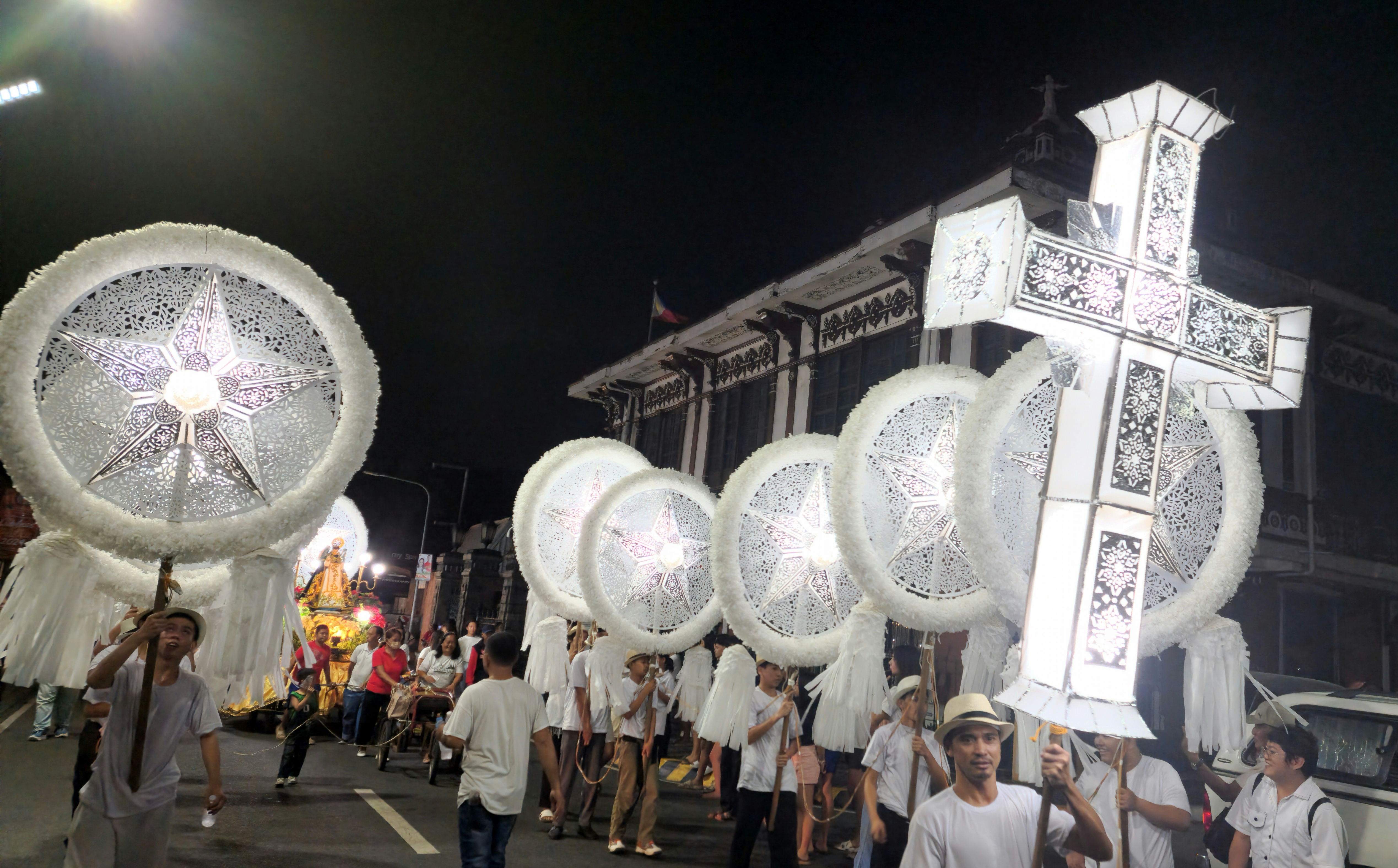
The present format of the lubenas, includes a cross-shaped lantern leading the procession, followed by people holding poles with twelve lanterns, arranged in two rows, representing the twelve apostles of Jesus Christ. Sometimes, a lantern in the shape a fish, a symbol of Jesus Christ, is included, usually placed behind the twelve lanterns. At the tail of the procession is the image of the barangay’s patron saint, carried on the shoulder or mounted on a carroza, bedecked with flowers and illumined by a giant lantern behind it, and devotees singing “Dios te Salve.” The procession can be accompanied by a brass band or a guitarist. 

The final lubenas on the eve of Christmas, in which processions of different barangays or chapels, converge at the church, is called maitinis in some towns, said to be derived from the Spanish maitines, the first of the seven canonical hours of prayer, observed after midnight or early hours of dawn. The maitinis is followed by the Misa de Gallo and Noche Buena. 

The practice of lubenas can vary in different towns. In some, maitinis is only observed. In Santa Ana, the majigangga, a giant puppet representing John the Baptist, and simple lanterns in the shape of a tent were incorporated until they were discontinued. In San Fernando, lantern competitions were held at the end of the lubenas, which became a separate attraction and evolved into the now famous Ligligan Parul, a showdown of giant lanterns. 

            Many practitioners join the lubenas as panata, a common religious expression among Filipinos—a ritual vow or promise to ask favors from God (or any religious figures), as thanksgiving for favors granted, and to ensure overall wellbeing and good fortune.

The devotional practice though has diminished over the years. Presently, town and cities with existing lubenas include Bacolor, Angeles City, San Fernando City, Mabalacat, Mexico, Magalang, Santa Ana and Santo Tomas in Pampanga; and Bamban, Capas and Concepcion in Tarlac, which is part of traditional Kapampangan home range. 

            With renewed interest and intention of revival, events are being produced, reenacting the lubenas with participants now wearing costumes, geared towards being a holiday attraction with components such as lantern competitions and touristic spectacles such as a grand gathering and recently created festivals that proliferate in the country. These are usually organized by local governments. Lubenas are traditionally held by communities and local churches.


The pastoleras

In Mabalacat, the maitinis remains to be organized by the parishes, with a very visible youth participation including LGBTIQ+ people. 

            The procession was followed by the Solemn High Mass of the Lord’s Nativity. The simbang bengi in Mabalacat is known for using the pastolera, the collection of hymns in Latin, arranged by local musicians and performed during the ceremony. 

            Latin hymns had been sung in Masses in the Philippines until 1969, when Pope Paul VI promulgated the Novus Ordo Missae or new Roman Missal, allowing local languages in liturgy. However, a few areas in the Philippines retained the Latin hymns, especially during special occasions such as Christmas, including Mabalacat. 

            During the Mass, a choir sung a repertoire including the “Kyrie” (Lord Have Mercy, which is in Greek), “Gloria” (Glory to God in the Highest), “Credo” (Apostle’s Creed), “Sanctus” (Holy) and “Agnus Dei” (Lamb of God), believed to be from Missa de Pastores (Shepherds' Mass, a Christmas Eve mass honoring the shepherds who watched over the birth of Jesus Christ) of Catalan composer Antoni Vaqué. The voices were accompanied by music from violins, organ and cello, played by a group of musicians. 

            Shepherded by faith and tradition, parishioners packed into church, spilling into the patio and grounds, as soft drizzle began to fall.   


Participants from different chapels in Mabalacat trooped out of the Our Lady of Grace Parish Church for the maitinis procession (Photo by Roel Hoang Manipon)

Bright lanterns from a group from Santa Ines illumine the  maitinis procsession (Photo by Roel Hoang Manipon)

Devotees from the  sitio of Lourdes in San Francisco (Photo by Roel Hoang Manipon)

Devotees from the barangay of Mamatitang in a procession (Photo by Roel Hoang Manipon)

Devotees carry Chrtistmas lanterns to the church for the maitinis procession (Photo by Roel Hoang Manipon)

A cross-shaped lantern leads the maitinis procession (Photo by Roel Hoang Manipon)

The carroza of the baranagy of San Joaquin (Photo by Roel Hoang Manipon)

The corroza and lanterns of the sitio of Homesite, San Francisco, after the procession (Photo by Roel Hoang Manipon)

Parishiopners attend the Misa de Gallo at the Our Lady of Grace Parish Church, known for its pastoleras (Photo by Roel Hoang Manipon)


Monday, December 30, 2024

Angeles City Promotes its Lanterns and Lubenas


Eye-catching lanterns marked the lubenas presentation

The heritage district of Angeles City in Pampanga, scintillated with more than a hundred Christmas lanterns as residents and devotees of eight barangays gathered together for “Ing Lubenas ning Pasku 2024” on December 14, 2024.

            Held before the actual start of lubenas, the special event was a showcase of creativity of local communities as manifested in eye-catching, hand-crafted lanterns, the outstanding feature of the folk Catholic tradition held during the Christmas season. 

The lanterns were all lit up, powered by portable generators or batteries, adding to their attractiveness, as the barangay groups participated in a procession in the early evening, after a mass, starting at the Holy Rosary Parish Church, going around the city proper, and ending at the church, where a program followed.

            The barangay of Cutcut showcased the lanterns created by the family of sixty-six-year-old Renato “Rene” Feliciano Calma, who is considered one of the city’s master lantern makers and who has introduced several ways of making the lanterns, including the intricate designs. While not coming from a lantern-making family, he is able to pass on the knowledge and skill to his children, to his own community and even to other towns, such as Magalang, where the lubenas was recently revived.  

            Most of these lanterns were made of paper with bamboo frames, but other materials were also used such as dried vines in the lanterns of Santa Teresita.

            Aside from Cutcut and Santa Teresita, the other participating barangays were Malabanias, Pampang, Pandan, Pulungbulu, Santo Domingo and Santo Rosario.

Organized by the city government and attended by local politicians, the program was held on Santo Entierro Street, in front of the church, the city’s only cobblestone road that is still existing, where each barangay presented a three- to five-minute performance, including elements of dance, singing, street drama and formation making using the lanterns to the accompaniment of an official song, composed for the event. 

            This part of the event is a very recent addition, more along the line of recently created touristic festivals that pervade the country. A similar event is being held in the neighboring town of Magalang, where a lantern design competition is also held. The Angeles City event did not involve a formal competition, but each participating barangay received a cash incentive of P100,000 and certificate of recognition from the city government, led by its mayor, Carmelo “Pogi” Lazatin, Jr. to the delight of participants. These are efforts in reinvigorating a dying practice that is traditionally sustained by local parishes and communities. 

             Held for nine days before Christmas, from December 16 to 24,  in Pampanga and Tarlac, the lubenasis a devotional procession on the eve of the simbang bengi, the dawn mass. It is a small, usually solemn, event within a barangay and centered around its chapel. It is believed that the ritual started in early 1800s, and the name was derived from the word novena. 

The devotees held lit candles during the novena procession with coverings to prevent the wind from blowing out the flames. Eventually, lanterns were used, first lit by candles and then by gas lamps and electric light bulbs. The lanterns evolved from simple forms into star-shaped ones with designs. The Kapampangans are believed to have pioneered the Christmas lanterns, which have become an icon of Filipino Christmas celebration.

The present format of the lubenas includes a cross-shaped lantern leading the procession, followed by people holding poles with twelve lanterns, arranged in two rows, representing the twelve apostles of Jesus Christ. Sometimes, a lantern in the shape a fish, a symbol of Jesus Christ, is included, usually placed behind the twelve lanterns. At the tail of the procession is the image of the barangay’s patron saint, carried on the shoulder or mounted on a carroza, bedecked with flowers and illumined by a giant lantern behind it, and singers singing “Dios te Salve.” 

The final lubenas on the eve of Christmas, in which processions of different barangays converge at the church, is called maitinis in some towns, preceding the Misa de Gallo. 

The lubenas was held in several towns around the foot of Mount Arayat in Pampanga, and in some towns in the neighboring province of Tarlac, but the practice has diminished over the years. Presently, the lubenas is said to be held in Bacolor, Angeles City, San Fernando City, Mabalacat, Mexico, Magalang, Santa Ana and Santo Tomas in Pampanga; and Bamban, Capas and Concepcion in Tarlac. More research are needed to document local history and lore, the extent of present practice and the variations in some barangays.

In recent years, renewed interest on the lubenas led to recent endeavors and additions that not only aim at revival and continuity but also are geared towards making it a touristic holiday attraction. Such efforts may bring with it the danger of the tradition becoming pro forma, practiced in form but with diminished or altered meanings among participants; of people mistaking the showcase as heritage, displacing actual practice as in the cases of big festivals in the country; and the practice becoming reliant on local government and thus vulnerable to the fickleness of political landscape.

Traditions, which are products of evolution, will continue to evolve. It is hoped that stakeholders and bearers of cultural heritage may find ways to appropriately safeguard and continue traditions, mindful of its important role in culture, creativity, community and the spirit of the season. 


Participants getting ready for the procession in front of the Holy Rosary Parish Church (Photo by Roel Hoang Manipon)


The lubenas participants from the barangay of Cutcut

A lantern in the shape of a fish, a symbol for Jesus Christ, of the barangay of Santo Domingo

A cross-shaped lantern leads the procession
The lanterns of Santa Teresita were made of dried vines

The lubenas contingent from the barangay of Santo Rosario

The carroza carrying the barangay's patron saint is part of the lubenas ptocession  (Photo by Roel Hoang Manipon)

Renato F. Calma, widely regarded as one of the best lantern makers of Angeles City, in his home in the barangay of Cutcut.


Sunday, December 29, 2024

Giant Lanterns Illuminate San Fernando City


The ornate patterns of the giant lantern of Bulaon

Ten giant Christmas lanterns dazzled an audience of locals and visitors with intricate patterns, frenetic bursts of colors and lights that “danced” to music at this year’s Ligligan Parul on December 14, 2024, held at the parking area of the mall Robinsons Starmills on Jose Abad Santos Avenue, San Jose, San Fernando City.

The annual event, popularly called Giant Lantern Festival, is a main factor that makes Pampanga’s capital city and the regional center of Central Luzon the so-called Christmas Capital of the Philippines. The star of this is the giant lanterns made by communities in San Fernando. 

The lanterns are humongous discs that measure to 20 feet in diameter, mostly made of carton paper, and riddled with light bulbs that number from 7,000 to more than 10,000. Mounted on trucks, these lanterns are designed and created by lantern makers, mostly coming from several generations of makers. 

This 116th Ligligan saw the participation of ten barangays—Santo Niño, whose team was led by Janino Padilla (barangay captain), Byron Bondoc (lantern maker), Joseph Salac (head electrician) and Leslie Bondoc (rotor maker); Telabastagan, whose team was led by Elmer Manguerra (barangay captain), Arnel Flores (lantern maker), Ronaldo Aguilar (head electrician) and Jeremiah Balboa (rotor maker); San Juan, whose team was led by Claro Tolentino (barangay captain), Reynald S. Tizon (lantern maker), Ener G. Nicdao (head electrician) and Ariel C. David (rotor maker); Santa Lucia, whose team was led by Roland David (barangay captain), Karl Ernest Quiwa (lantern maker), Lamberto Dungca (head electrician) and Vonne Andrei Quiwa (rotor maker); San Jose, whose team was led by Loreto Tumang (barangay captain), Christopher Doloiras (lantern maker), Jeffrey Balagtas (head electrician) and Juanito Galang (rotor maker); Del Pilar, whose team was led by Jerry Canlas (barangay captain), Florante Parilla (lantern maker), Jun Batac (head electrician) and Eduardo Dizon (rotor maker); San Nicolas, whose team was led by Jerwin Sembrano (barangay captain), Edmar M. David (lantern maker), Edwin M. David (head electrician) and Angelica M. David (rotor maker); Calulut, whose team was led by Jaime Q. Capil (barangay captain), Marcelino Ambrosio (lantern maker), Maricel M. Maglalang (head electrician) and Harold M. Asuncion (rotor maker); Dolores, whose team was led by Allan Patio (barangay captain), Teddy Aguilar (lantern maker), Wesley Marin (head electrician) and Eugene Aguilar (rotor maker); and Bulaon, whose team was led by Lavernie Gopez (barangay captain), Mark Niño Flores (lantern maker), John Luigi Flores (head electrician) and Arnold Flores (rotor maker).

            These lanterns competed in three rounds—Round 1, in which they were given seven minutes to display their lanterns individually with music of their choice; Round 2, in which the lanterns were divided into three groups, with each group given five minutes for a lantern showdown to the accompaniment of music that was to be revealed; and Round 3, in which all lanterns participated in a grand showdown, in accordance to the traditional ligligan parul, accompanied by a live band, the Lumanog Band 48, under the baton of Edwin Lumanog, from Betis, Guagua. 

The lanterns were judged according to interplays of lights and color with music in the first round, and interplays of lights and music in the second and third rounds. They were also appraised for their designs, which included harmony, organization and beauty; color combination; and the so-called “X factor” that included uniqueness, appeal to crowd, special features and “proper decorum.”

            After exuberant displays, the barangay of San Nicolas was declared as this year’s champion, followed by Santo Niño (first runner-up), Bulaon (second runner-up), and Telabastagan (third runner-up).

            The 10 giant lanterns are still on display at Robinsons Starmills putting up nightly shows from December 15 to 23 and 25 to 30 and on January 1, 2025.

During the Liligan, the lantern makers are also aptly considered the stars of the show. Part of the program is dedicated to paying tribute to master craftsmen. This year, the San Fernando local government awarded the Lifetime Achievement Award to one of the oldest living lantern makers in the city, Edwin Pineda David, Sr. 

            David is honored “as one of the giant lantern makers who ensure the survival of San Fernando's longstanding tradition,” and for “unparalleled dedication and outstanding contributions in the field.”

“A protege of his uncle, Maning David of Barangay San Nicolas, Edwin Pineda David, Sr., now 78 years old and a second-generation lantern maker, started making Lanterns in 1965,” San Fernando tourism officer Ching Pangilinan shared. “Popularly known as Bapang Potpot, he made his debut as a giant lantern maker in the 1980s. Ang magaling dito (what is great here), he passed the craft to three of his sons, Edwin, Edmar, and Marwin, and daughter Angelica. Edmar David, with his more than 15 years of lantern-making experience, is leading their home Barangay San Nicolas this year as they vie for the championship.”

San Fernando City is known for its cottage industry of Christmas lanterns and has the longest existing tradition of the craft, passed down to several generations within families. At the Ligligan, members of lantern making families from different generations worked together, with young lantern makers trying their hand on making lanterns and continually learn from senior members.

The Ligligan Parul, which literally means “lantern competition,” has been held more than a century now, tracing its roots to the lubenas. 

“Ing particular a tradition a gagawan ming a ini, meg-umpisa ya anyang, sasabyan da ring matwa, anyang minuna panaun da pa reng Kastila. Atin tamung awsan dang “lubenas”. Ing kasing San Fernando balamu tutukyan ne itang plaza complex, nung nukarin atin ta’ng pisamban a maragul kayarapan na ning munisipyu at ating mga bisitas, o malalating kapilya na atsu ka ring barrios. Dening barrio nga reni, melagyu la karing miaaliwang santo o patron. At potang magpasku, itang siyam a aldo bayu ing pasku, dening malalating bisitas dadala do ring patron da reng barrio kening maragul a pisamban. At, kayabe da reni ring linternas or parul. Karin megumpisa itang pamiligligan da ring miaaliwang barrio. Anyang mumuna kanu ing lubenas atin lang twelve pairs of lanterns, dose paris a parul na pare-parehu ing itsura ampong metung a parul na makahugis o esken na apin ing krus na magrepresenta o bilang iyang tatalakad bilang simbolo ng Kristo. Uling ping religious ya in nature itang maging praktis da. Pero, kayari na nita at meg-umpisa na lang gawang miaaliwang disenyu ding Fernandinos, miaaliwa na la kule at aliwaliwang materyalis (This particular tradition that we practice started, according to the elders, during the Spanish times. We had what we call lubenas. San Fernando followed the plaza complex design, in which they had a big church fronting the municipal hall, and they also had the visitas, or the little chapels in the barangays. These barangays were named after different patron saints. During the Christmas season, the nine days before Christmas, these small churches brought their patron saints to the big church. They were accompanied by lanterns. This was how the contest among barrios started. In the early years, the lubenas had twelve pairs of lanterns, which looked the same, and one lantern in the shape of the cross representing or symbolizing the Christ. Because this was religious in nature, their tradition. But then, the Fernandinos started making lanterns of different designs, different colors and different materials),” Pangilinan explained.  

            While the lubenas is still being practiced in San Fernando, the Ligligan, which may be considered an offshoot of the lubenas, developed to be its own practice, requiring specialized skills and knowledge. 

The giant lantern making is an intangible cultural heritage element that has undergone substantial evolution, and incorporation of modern elements and technology. For example, the candlelight that illumined the lanterns were replaced by lamps powered by car batteries using switchboard technology. Then, the rotor was invented and introduced in 1950s, becoming one of the most important developments, changing the looks of the lanterns by enabling the play of lights. This year,  the more durable and environment-friendly LED technology was used for the first time. The giant lanterns remain, however, as a spiritual expression of the community and a impressive showcase of creativity.


Makers and workers worked on their giant lantern in San Nicolas, San Fernando City, on 9 November (Photo by Roel Hoang Manipon)


Lantern maker and designer Marcelino Ambrosio worked on the rotor of  Calulut's giant lantern in early November (Photo by Roel Hoang Manipon)

Workers installing the bulbs and wiring on the giant lantern of the barangay of Del Pilar (Photo by Roel Hoang Manipon)

The 20-foot lanterns, mounted on trucks, were set up for the Ligligan Parul (Photo by Roel Hoang Manipon)

Lanterns show their mesmerizing lights and patterns during a showdown of Ligligan Parul (Photo by Roel Hoang Manipon)

The giant lantern of the barangay of  San Jose (Photo by Roel Hoang Manipon)


People take pictures with the lantern of the barangay of Santo Niño (Photo by Roel Hoang Manipon)

The rotor, the lantern, determines the way the lantern lights up its intricate patterns (Photo by Roel Hoang Manipon)

The barangay of San Nicolas was declared champion of the Ligligan Parul 2024 (Photo by Roel Hoang Manipon)


Monday, December 23, 2024

Magalang’s Christmas Event Features Lubenas Tradition, Dazzling Lanterns and Orchestra Concert


Procession particpants gathered at San Bartolome Church for mass and ‘Ing Banal a Batuin ning Magalang' (Photo by Roel Hoang Manipon)

More than 400 bright Christmas lanterns, in the shape of stars, crosses and fish, and bearing intricate embellishments, lit up the streets in the town proper of Magalang on December 13 for “Ing Banal a Batuin ning Magalang: Lubenas Ning Pasku 2024” (The Holy Star of Magalang: The Christmas Lubenas). 

Organized by the municipal government of the town in the northern part of the province of Pampanga, the Christmas event aimed to promote the Pampangan Christmas tradition of lubenas, which would start in a couple of days on December 16, and to celebrate the 161st founding anniversary of the town, the Aldo ning Magalang (Day of Magalang). It was able to gather 26 groups from almost all of its barangays for a grand procession and lantern competition.  


The Lubenas Tradition

            Among Filipinos, Christmas, which commemorates the birth of Jesus Christ, is the most beloved festivity. It was introduced by the Spaniards during the Spanish colonization of the archipelago and more practices were introduced by the Americans, but Filipinos also added their own flavors to the celebration, particularly the Kapampangans, who introduced the lubenas most likely in the early 1800s. 

            The lubenas, whose name is said to be derived from the word novena, is a procession held in different barangays on eve of the simbang bengi, the dawn mass, for nine days before Christmas. The final lubenas on December 24 is called maitinis in some towns. 

The procession, a land-based kind called limbun, is led by a cross-shaped lantern, followed by people holding poles with twelve parul or Christmas lanterns, arranged in two rows, representing the twelve apostles of Jesus Christ. It also includes lanterns in the shape a fish, a symbol of Christ, or other animals such as lamb, dove and those that usually figure in the Nativity scene; the image of the barangay’s patron saint, carried on the shoulder or mounted on a carroza, illumined by a giant lantern behind it; and singers singing “Dios te Salve.” Early paruls were simple, made of paper and lit by candle flames. Over the years, lanterns became bigger and more elaborate. Additionally, carbide lamps and then electric light bulbs were used.

            The lubenas were practiced in several towns around the foot of Mount Arayat in Pampanga, and in some towns in the neighboring province of Tarlac. The devotional practice though has diminished over the years. The towns and cities with existing lubenas include Bacolor, Angeles City, San Fernando City, Mabalacat, Mexico, Magalang, Santa Ana and Santo Tomas in Pampanga; and Bamban, Capas and Concepcion in Tarlac. Santa Ana also practiced making the majigangga, giant scary puppets symbolizing evil, which danced on the streets of the town from December 16 to 24 and would be banished by the coming of Christ. The last known practice was held in 2021. 

            In recent years, there is renewed interest on the lubenas and its revival. A recent development of the practice is additions made to be a holiday attraction such as lantern competitions and touristic spectacles such as a grand gathering, like the “Ing Banal a Batuin ning Magalang,” which is considered as an introduction to the lubenas.


Reinvigorating the Lubenas 

            For the reinvigoration of the lubenas and lantern-making in Magalang, master lantern maker Renato “Rene” Calma from Cutcut, Angeles City, was tapped to teach younger Magaleños how to make the parul, including techniques and decorative features that he himself devised.    

The local government granted subsidies for the barangays for the making their lubenas lanterns, adding to the resources that residents were able to pool together.   

            At the “Ing Banal a Batuin” event, 26 contingents of procession participants converged at Magalang’s San Bartolome Church, many in costumes inspired by traditional Filipino or old attires, and religious imagery, bearing the lanterns they made in the past weeks. 

            A mass was held in the early evening, followed by the lantern parade and a mini concert featuring the Philippine Philharmonic Orchestra and the vocal group The Nightingales, presented in partnership with the Cultural Center of the Philippines. 

The event, led by Magalang mayor Maria Lourdes Paras Lacson and tourism officer Ryan Miranda, was graced by local and national government officials and representatives as well as tourists, who were afforded a glimpse of the lubenas in a grand manner.

            The night culminated with announcement of the winners of the lantern competition. The barangay of San Jose was again declared as the champion. The contingent was also judged champion in the last two years of the competition. The designer of the lanterns is Syrus Feliciano, who learned the craft from Calma. The lanterns were made by residents and young people led by the Sangguniang Kabataan of the barangay. 

            The other winners are contingents from the barangays of Santa Maria (second place), Santa Lucia (third), San Isidro (fourth), and San Ildefonso (fifth).

            The San Jose group was invited to participate at the country’s biggest multi-arts festival, Pasinaya: The CCP Open House Festival, on February 4 at the Cultural Center of the Philippines Complex in Pasay City, promoting the Pampanga Christmas lanterns. 


From Magalang to Milan

The local government of Magalang was able to promote the lubenas and the craftmanship in latern-making abroad. With the support of the Consulate General of the Philippines, led by consul general Elmer Cato, and the Filipino community in northern Italy, Pampanga lanterns made an appearance at the Basilica di Santo Stefano Maggiore in Milan during a simbang gabi on December 15. The lanterns were designed and made by Calma, commissioned by the Magalang government. 

The lanterns again appeared at the Duomo di Milano or the Metropolitan Cathedral-Basilica of the Nativity of Saint Mary for the second day of simbang gabi. 

The giant parul Sampernandu, which traces its roots to the lubenas tradition, has been showcased internationally several times in the past. The Milan events are said to mark the first time for lubenas lanterns to be shown internationally, bringing Filipinos abroad closer to home and their heritage in Christmas celebration.


Early forms of Pampanga's lanterns were lit by candlelight (Photo by Roel Hoang Manipon)


Procession particpants gathered at San Bartolome Church for mass and ‘Ing Banal a Batuin ning Magalang' (Photo by Roel Hoang Manipon)

The 12 paruls represent the 12 apostles of Jesus Christ (Photo by Roel Hoang Manipon)

The fish-shaped lanterns of the Santa Lucia group (Photo by Roel Hoang Manipon)

The residents of Camias gathered at the Virgen Delos Remedios Chapel to make their lanterns in early November (Photo by Roel Hoang Manipon)

A contingent from San Pedro II (Photo by Roel Hoang Manipon)

The eye-catching lanterns of the San Isidro group (Photo by Roel Hoang Manipon)

The group from San Jose was declared champion for third time (Photo by Roel Hoang Manipon)