Showing posts with label National Museum. Show all posts

Saturday, July 23, 2016

Wonder World of Weaves: The Textile Galleries of the National Museum


Inside the glass encasement, with its micro-weather of controlled temperature and humidity to halt further damage, the object appears to be a map of ancient lands, very different from what we know of present geography, its crannies remaining uncharted. At one point, it looks like an old puzzle, with pieces forever missing and patterns, obscured by age, at once familiar and inscrutable.
This is actually the oldest piece of textile in existence in the Philippines. Called the Banton cloth, it is estimated to be from the thirteenth to the early fourteenth century. Considered to be the earliest specimen of wrap tie-dyed textile in Southeast Asia, the Banton cloth was discovered in April 22, 1966 by a team from National Museum, after being informed by a local of cave complex, an ancient burial site, in Banton Island of the province of Rombon in Central Philippines. Inside the already disturbed cave, the team found wooden coffins, Chinese stone jars, Chinese and Siamese plates and bowls, ornaments, glass beads, turtle shell combs and the abaca cloth, which measures 74.5 centimeters in length and 75 centimeters in width. It was declared a National Cultural Treasure in 2010.
Museologist and anthropologist Ana Maria Theresa Labrador, assistant director of the National Museum of the Philippines, theorizes that the Banton cloth may be a trade object, brought to the island from other areas, even from outside of the Philippines.
On the other hand, Philippine traditional arts scholar and professor Dr. Norma Respicio, in her book Journey of a Thousand Shuttles: The Philippine Weave (2014), writes: “The interplay of plain stripes and designed bands in the Banton cloths attests to the dexterity of the textile producer in the art and technology of weaving, dyeing and ikat designing where interfaced designs are produced through the tying of certain parts of the warp yarns in a series of folds. Moreover, the designs, both the non-figurative and the figurative forms, bear social and cultural significations in traditional Philippine aesthetics.”
Which ever, the Banton cloth remains to be a mystery that tantalizes both the scholars and the layman visitors, an enigmatic gem of the National Museum (NM) for several years. Now, the precious artefact has a new home, though still within NM. The museum has unveiled a new section dedicated to Philippine textiles and the art and technology of weaving at the third floor of the Museum of the Filipino People (old Finance Building). The Queen Sofia Hall and Hall 318 were converted into the Textile Galleries, which was formally unveiled in May 18, 2012. In September 21, their permanent exhibit, “Hibla ng Lahing Filipino: The Artistry of Philippine Textiles,” began seeing visitors.
The idea for the Textile Galleries sparked when like-minded individuals met and then collaborated. NM credits Loren Legarda as a moving force behind the creation of the galleries. The senator¸ who chairs the Senate Committee on Cultural Communities, has been promoting traditional woven textiles, her passion which became part of her advocacy to preserve indigenous culture. Legarda has been known for wearing gowns fashioned from hand-woven traditional fabrics and has showcased native fabrics and Philippine attires in several exhibits in the Senate.
“But I have long dreamed of seeing a textile museum in my own country,” she revealed. “With more than a hundred indigenous cultural communities in our country, we should showcase our rich culture and the distinctiveness of our own habi.”
In 2010, Legarda met NM director Jeremy Barns and Labrador, which started the ball rolling, overcoming the hurdles that came their way.
NM sourced from its own collections to put into the Textile Galleries. Other government agencies and institutions became partners and supporters in the endeavour including the Office of Senator Loren Legarda, the National Commission for Culture and the Arts, the Fiber Industry Development Authority (FIDA) of the Department of Agriculture, the Philippine Textile Research Institute (PTRI) of the Department of Science and Technology, and the University of the Philippines’ Asian Center.
The Aklan Provincial Tourism Council and HIBLA contributed additional looms. Congressman Victor Ortega of the First District of La Union, Ilocos Sur vice governor Deogracias Victor Savellano and councilor Edmund Gavina of Bangar, La Union also contributed items to the museum.
“It’s really convergence,” Legarda said. “There is really cooperation and convergence among government agencies.”
Labrador served as chief curator of the exhibition, which aims to provide a preliminary survey and study of the similarities of the traditional textiles.
“We finally thought we should really think about nation and how textiles bind us a nation,” Labrador related. “So, we look at the common practices, common threads, common fibers, that are really kind of found all over the country.”
“The word is commonality and the ties that bind, the threads of life,” Legarda affirmed. “These are perhaps three phrases or words that formed part of the work we’ve done here, because we are an archipelago, we have many ethno-linguistic groups, we have about 80 provinces with about 41,000 barangays, we have more than a hundred of languages. We’re so diverse. But textiles, and with the various textiles, however, we try to find the commonality, the unity amidst this diversity. That is what we’re pushing for here. We do not want to further divide the nation by displaying the textiles geographically. So, what Ana did was to the find the ikat of the North and the ikat of the South, or the embroideries of the Cordilleras, which have commonality with those of the Muslim groups….”
      “Hibla ng Lahing Filipino” looks into the likenesses, exchanges and borrowing of designs and forms in local weaves, believing that they can be coaxed to reveal visions of a national identity through threads that when woven as textile, may piece together their different stories.
The exhibition tells the processes of weaving, informing visitors first of the different fibers used by the different ethnic groups with weaving traditions. Abaca and cotton are commonly used by many ethnic groups. An attractive chart, reproduced from the 2009 book Bahaghari: Colors of the Philippines, shows the natural dyes that have been used all over the Philippines, from the karimbabul to the malunggay.
The different looms used by different groups, such as the foot loom and the back-strap loom, are displayed in one area, enabling visitors to compare and contrast. Other production materials can also be seen and marveled at. The finished textiles are laid out to reveal their beauty..
The exhibit illustrates the social significance of textiles in different communities, the roles they play in rituals and in life, from birth to death. Aside from the Banton cloth, another National Cultural Treasure is on display—the kinuttiyan of the Ifugao, a ritual death blanket of the kadangyan, the high-ranking members of the Ifugao community. The one here is collected in June 13, 1968 by William Beyer in Amanagad, Banaue, Ifugao.
Additionally, large photographs of several indigenous people wearing their traditional attires, such as the Mandaya, decorate the walls, taken by prominent photographer Wyg Tysmans. At another are historic photographs of several ethnic groups in traditional garb at the 1904 St. Louis Exposition (courtesy of the American Museum of National History archives).       
Also part of the exhibit are gowns, dresses and barong Tagalog by prominent fashion designers such as Jojie Lloren, Cesar Gaupo, Barge Ramos, Frederick Peralta, Milka Quin and Roy Gonzales.
The Textile Galleries are not only repositories of precious artefacts and specimens but they also serve as venues for lectures and live weaving demonstrations by actual weavers, which are occasionally mounted during Fridays and Saturdays.
The Senator Loren Legarda Lecture Series on Philippine Traditional Textiles and Indigenous Knowledge officially started on March 13, 2012, along with the preview of the Textile Galleries.
“In this modern day and age, it is quite a difficult task to make our people embrace our culture since many may have long forgotten about it. But if they refuse to visit our history, we must let history visit them. These Textile Galleries and the lecture series we organized are some of our efforts towards that,” Legarda commented.
Tagabawa Bagobo weavers, piƱa weavers from Aklan, weavers from the Cordilleras as well as from the Ilocos Region have been brought in for visitors to witness and experience actual weaving. Mat and basket weavers from different cultural communities have also been invited.
 Labrador admitted that the galleries are not thoroughly comprehensive. “We chose because it can’t possibly accommodate everything, but we’re hoping someday we can have a standalone museum for textiles,” she said.
“It’s a work in progress,” Legarda added. “I’m not saying it’s perfect but we’re trying.”
Right now, ideas, plans and dreams are being woven.
Legarda mentioned plans of bringing in the textile collection of one of Philippines’ most revered heroes, Jose Rizal. It is presently at the Ethnological Museum of Berlin in Germany. Another plan is the collection of sketches of Filipino fashion designers, which are usually discarded after use.
“What we want to do is also to create an archive of Filipino fashion designs,” Labrador revealed.  “We want to be a reference later on for maybe designers or merchandisers, [a place to] look at what we have. It’s really to inspire later on to generate more innovations and designs.”
She also said that they’re starting a program on “economic botany” in collaboration with FIDA and PTRI “because we want to be more relevant to local people.”
“So, we’re experimenting now with fibers to see if we can harness them that can be turned into something else so that local people could actually have a means of livelihood,” Labrador said.
With these, the National Museum is tying together life and death, tradition and innovation, past and future, and the different cultures with imagination and the fibers of our country.


The exhibition features different kinds of looms in the Philippines as well as other implements for weaving and the finished textiles. Large-scale photographs by Wig Tysman features selected indigenous peoples in their traditional wear


Both traditional attires and gowns made by contemporary designers, using hand-woven fabrics, are on display at the Textile Galleries


The Banton cloth, estimated to be from the thirteenth to the early fourteenth century, is the oldest exsiting piece of cloth in the Philippines and is considered to be the earliest specimen of wrap tie-dyed textile in Southeast Asia. It was discovered in a disturbed burial site in Banton Island, Romblon, along with other artefacts. /Photo from the National Museum of the Philippines

 The kinuttiyan, made of cotton and dyed using the binudbudan or wrap-ikat tie-dyed resist technique,  is the ritual death blanket of the kadangyan, the high-ranking members of the Ifugao community. This specimen, declared a National Cultural Treasure, was collected in June 13, 1968 by William Beyer in Amanagad, Banaue, Ifugao. /Photo from the National Museum of the Philippines
Museum of the Filipino People, where the Textile Galleries are, is part of the National Museum complex and is located along Finance Road, Ermita, Manila. Visiting hours are from 10 A.M. to 5 P.M., Tuesdays to Sundays. For more information, visit www.nationalmuseum.gov.ph.


Wednesday, June 25, 2014

Honoring a Father, Teacher and Anthropologist: Dangal ng Haraya Award Bestowed to F. Landa Jocano

Eminent anthropologist F. Landa Jocano
For a son, he was a man always on fire. For a colleague, he was an esteemed guide and teacher. For a whole nation, he was a symbol for inspiration and someone it owes an immeasurable debt of gratitude to. F. Landa Jocano had always been the indefatigable researcher and pioneering anthropologist. 
The magnitude of his contributions to the Philippines was realized when he passed away on October 27, 2013, due to cardiac arrest at the age of 83. Tributes have been held. Several months later, the National Commission for Culture and the Arts (NCCA) posthumously bestowed him its highest recognition, the Dangal ng Haraya, an award for a lifetime of achievements in the arts and cultural work. 
Jocano was honored, the citation reads, "for his exemplary contributions in the field of cultural and historical research, having pioneered the use of participant observation a methodology in Philippine ethnographic research" and "for being one of the earliest Filipino social scientists who used his rigorous trainings in anthropology as evidenced by earning his Ph.D. to produce numerous groundbreaking studies and published works which served as reference materials of educational institutions in the country and the basis for creative cultural work."
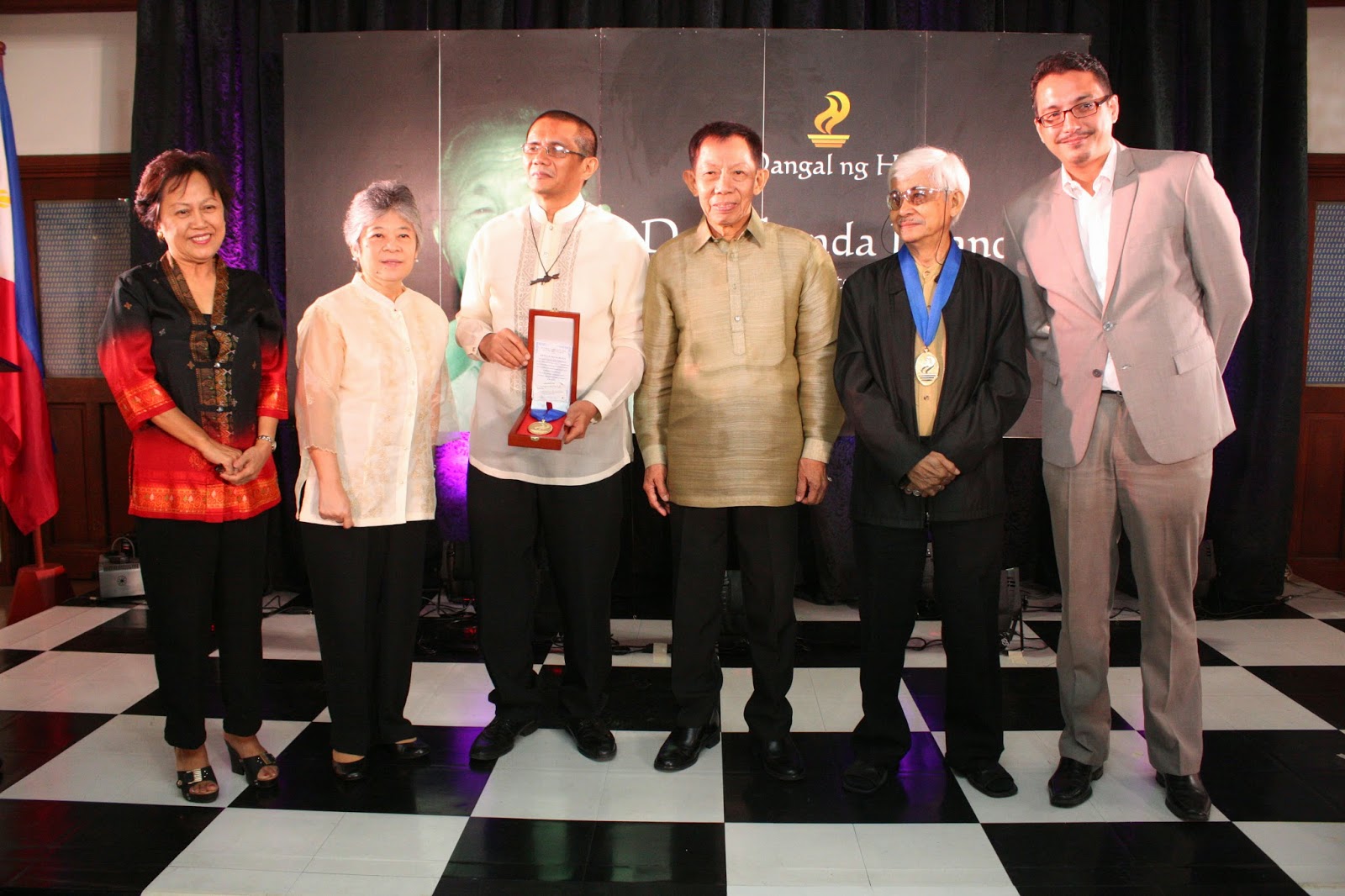
The simple and intimate ceremony was held on May 22, 2014, at the NCCA Building in Intramuros, Manila. It was attended by NCCA officials led by its chairman Felipe de Leon Jr. and acting executive director Adelina Suemith; Jocano's friends and colleagues; and personages in arts and culture. An excerpt of a Panay Bukidnon chant was performed by Rodolfo Caballero, Panay Bukidnon chanter from Calinog, Iloilo.
National Museum director Jeremy Barns announced that they will be naming a wing after Jocano at the museum, which is undergoing renovation and expansion after finally reacquiring the building which housed the Department of Tourism. This came as a sweet surprise as Jocano's career started at the National Museum.
Receiving the Dangal of Haraya award was Jocano's son, Dr. Felipe Jocano Jr., who is also an anthropologist. His reminiscences on his father were insightful, entertaining and inspiring. He could have gone on and on all night long, and maybe for several nights, like the epic chant Jocano helped popularize and preserve, but time was severely limited.
A former student who became Jocano's collegue, Dr. Carolyn I. Sobritchea, lecturer at the Asian Center, attempted to sum up his works and contributions, refreshing the memories of those familiar with him and educating those who weren't. Sobritchea had assisted him in researching and writing his books on slum life and the Sulod. She also edited and proofread some of his works.
Jocano was known for his pioneering works in anthropology in the Philippines, particularly his work on Philippine prehistoric civilization.
"He is widely known, here and abroad, for his numerous field studies and publications on Philippine folklore, prehistory, cultural communities, folk medicine and organizational culture," Sobritchea said.
Born into a farming family in Cabatuan, Iloilo, on February 5, 1930, ninth of eleven children, Jocano ran away to Manila after finishing elementary school because his family could not afford to send him to high school. He worked his way through secondary school at the Arellano High School. He returned to Iloilo in 1954 where he finished a Bachelor of Arts degree at the Central Philippine University in 1957. During this period, he developed an interest in folklore. Eventually, he began searching for and studying epics in the Philippines, leading to the publication of the Hinilawod, a Central Visayan Folk Epic, for which he is widely known.
It began with a question to a literature professor, related Jocano Jr. The professor was teaching epics such as The Odyssey, the Iranian epics and Le Morte d'Arthur. Jocano asked if we have epics of our own. The professor answered, "Well, we don't. If you want to find out, go ahead."
"Thus began a journey in looking for epics which led to Central Panay. After he recorded the chant, he went back to his professor. He went and found it. That was the kind of person my father was," he said.
Jocano came to work at the National Museum through noted anthropologist Robert Fox. Through a grant, he pursued graduate studies at the University of Chicago, earning a Master in Anthropology in 1962 and a doctorate degree in Social Anthropology in 1963.
When he returned to the Philippines, he taught at the University of the Philippines.
"Dr. Jocano taught at the University of the Philippines for nearly half a century," Sobritchea said. "He first joined the Department of Anthropology in l967 then moved to the Asian Center in 1973 as professor of Philippine Studies. He served as chairman of the UP Department of Anthropology, director of Philippine Studies Program at the UP Asian Center, dean of the UP Institute of Philippine Studies, and head of Asian Center Museum Laboratory. He played a key role in developing the content and direction of the graduate program in Philippine Studies as well as the training programs for government personnel of various government agencies such as the Foreign Service Institute of the Department of Foreign Affairs, Department and the National Defense College. As the head of the Asian Center Museum Laboratory, he spearheaded the collection of cultural materials and photographs of ethnic groups across the country for use in graduate studies and appreciation, primarily of scholars and students. He strongly argued for the rereading of pre-colonial history and challenged the overly diffussionist slant of early works on this period.
"Many of Dr. Jocano's pioneering studies on Filipino values, folk medicine and early-childhood socialization practices, among others, provided rich data for the development of culturally-sensitive policies and programs of schools and various government agencies," she continued. "Indeed, his pioneering efforts to influence development practitioners to ground their work on anthropological knowledge have immensely contributed to the pursuit of policies, programs and services that are attuned to the diverse values, social contexts and aspirations of Filipinos."
For these, Jocano received numerous awards including the Ten Outstanding Young Men; (TOYM) award in 1965l; the 1971 Cultural Heritage Award, given by the Philippine government; and the National Science Special Award of Merit in 1974, given by the National Science Development Board (NSDB). He was also listed among the 12 Top Scientists of the Philippines by the National Research Council of the Philippines in 1988.
"For us in the social science, this is a dream," Sobritchea said.
Other awards included lifetime achievement awards in 2006 from the National Museum and the UP Archaeological Studies Program. In 2007, he was conferred the membership into the Philippine Legion of Honor with the rank of Maringal na Pinuno (Grand Officer).
"But what is perhaps the most valuable contribution of Dr. Jocano is the knowledge and skills he imparted to his students," Sobritchea averred. "As a classroom teacher and fieldwork supervisor, he is fondly remembered for teaching people-centered ways of doing social science research. He ensured the safety and security of everyone in the field even as he also cautioned them to be always respectful of the norms and practices of the communities being studied. He passed on to his students the legacy of grounded theorizing and reflexive ethnography. "
Those who were not personally taught by Jocano learned from his numerous books, which include Sulod Society (1968); Growing Up in a Philippine Barrio (1969); Folk Medicine in a Philippine Community (1973); Slum as a Way of Life (1975); Ilocano: An Ethnography of Family and Community Life (1983); Hiligaynon: An Ethnography of Family and Community Life (1983); Filipino Indigenous Ethnic Communities: Patterns, Variations, and Typologies (1998); and Filipino Prehistory: Rediscovering Precolonial Heritage (1998).
Jocano's contribution to the study of Philippine folk literature is the documentation and translation to English of the folk epic Hinilawod of the indigenous Panay Bukidnon of Western Visayas. From 1955 to 1957, he spent time with the Panay Bukidnon chanters and eventually published the book Hinilawod: Adventures of Humadapnon (Tarangban I), reprinted 2007. Jocano Jr. was six years old when his father was transcribing Hinilawod. It was the sound to which he which he fell asleep.
The anecdote was a glimpse on Jocano's work and family life fused together. Many times, his work influenced family life. Jocano Jr. remembered his father to be "always on fire from one idea to another."
"His unstoppable nature affected his family," he said.
He recalled for two years, they lived in the slums when his father was studying slum life. He remembered the violence in the community. His father joked, why go to action movies when the real action is here.
Jocano Jr. also said his father was a complex individual; it was not easy to define him. Similarly, his works are not easily classified-whether folk literature, prehistory, ethnography and others. But almost everyone is sure of one thing-the inestimable value and impact of his works.
Jocano joins his fellow Dangal ng Haraya awardees, Dr. Jesus Peralta for cultural conservation; Danny Dolor for cultural promotions; Felice Sta. Maria for cultural management; and E. Arsenio Manuel and Isagani Medina for cultural research, given on July 20, 2001; Efren Abueg, Lourdes Saquing Dulawan, Purita Kalaw Ledesma, Augusto Villalon, Basilio Esteban Villaruz, and the Philippine Association of Printmakers, given on August 9, 2002; Dr. Rustica Carpio for writing and art criticism; Amelia LapeƱa-Bonifacio for cultural management; Dr. Samuel Tan for cultural and historical research; and Pura Santillan-Castrence, Corazon IƱigo, Gilda Cordero-Fernando and the Organisasyon ng Pilipinong Mang-aawit headed by singer-actress Mitch Valdez for the promotion of Philippine culture, given on February 23, 2007; and senator Edgardo Angara for patronage of arts and culture, given on June 21, 2013.
The Dangal ng Haraya was usually given together with the Alab ng Haraya (Flame of Imagination). The two recognitions were created under the leadership of NCCA chairman Jaime Laya and executive director Virgilio Almario. Alab ng Haraya is given to artists, cultural workers, works, groups and institutions, who had made an impact and significant contribution to arts and cultural development in categories such as published series of articles on culture and the arts/cultural journalism or documentation, arts management, choreography in dance, library and information services program, production, individual recognition and cultural conservation. On the other hand, the Dangal ng Haraya is the lifetime achievement award.

The late anthropologist F. Landa Jocano’s son  Dr. Felipe Jocano Jr. accepted the Dangal ng Haraya, the National Commission for Culture and the Arts’ (NCCA) lifetime achivement award, for his father from NCCA acting executive director Adelina Suemith and NCCA chariman Felipe de Leon Jr.
Dr. Felipe Jocano Jr. reminisced about his father 

From left: Dr. Carolyn Sobritchea of the Asian Center, NCCA acting executive director Adelina Suemith, Dr. Felipe Jocano Jr., NCCA chariman Felipe de Leon Jr., anthropologist Dr. Jesus Peralta, and National Museum director Jeremy Barns