 |
| At about 570 meters above sea level, the Bacon-Manito Geothermal Complex is a 25,000-hectare protected area spanning the boundaries of Legazpi City and the town of Manito in Albay and the district of Bacon of Sorsogon City in Sorsogon. Within this area is the Pocdol mountains, a group of stratovolcanos; steaming mud pools in Inang Maharang; a “boiling lake” called Naghaso; the Botong Falls; thriving forests, usually of dipterocarps; and several communities. It is home of the flying fox and walking sticks unique to the area such as the Tisamenus deplanata “Pocdol.” Aside from its offices and the geothermal plant, EDC maintains a wildlife rehabilitation and refuge center which presently houses deer and wild boar, a butterfly garden and a 19-hectare mangrove plantation at the coast of Manito |
Amidst
the lush mountains that straddle the provinces of Sorsogon and Albay in the
Bicol region, select high school students, grouped into teams, were on
competitive challenge race. One challenge had them searching for food
items—ingredients for dishes they would cook—using compass bearings. Once
completed, they cooked, set the tables, ate what they prepared and washed the
dishes. Then, they proceeded to tackle more challenges—figuring out puzzles;
relaying water; rolling balls using only PVC pipes cut in half; moving balls
using a metal ring and pieces of strings; etc. These tested their agility,
creativity, communication skills and how they worked as a team.
This
was one of the culminating activities of the annual summer youth camp of the
Energy Development Corporation (EDC), the country’s leading producer of
geothermal energy, called Energy Camp or e-Camp. The e-Camp is different in
several ways. Most obvious is the setting of the camps. All of the camps are
held in the geothermal complexes of EDC, most of which are forest reserves and
protected areas. EDC maintains, manages and helps protects five sites around
the country—in Leyte, Negros, Albay-Sorsogon and North Cotabato.
At
about 570 meters above sea level, the Bacon-Manito Geothermal Complex is a
25,000-hectare protected area spanning the boundaries of Legazpi City and the
town of Manito in Albay and the district of Bacon of Sorsogon City in Sorsogon.
Within this area is the Pocdol mountains, a group of stratovolcanos; steaming
mud pools in Inang Maharang; a “boiling lake” called Naghaso; the Botong Falls;
thriving forests, usually of dipterocarps; and several communities. It is home
of the flying fox and walking sticks unique to the area such as the Tisamenus
deplanata “Pocdol.” Aside from its offices and the geothermal plant, EDC
maintains a wildlife rehabilitation and refuge center which presently houses
deer and wild boar, a butterfly garden and a 19-hectare mangrove plantation at
the coast of Manito.
Appropriately,
the camp curriculum includes lessons on the environment, environment-friendly
practices like composting, planting of endemic trees in denuded areas, hiking
to appreciate the outdoors and the processes of harnessing geothermal energy to
understand why it is the cleanest way of producing energy. Other lessons and
activities prove to be eclectic. Campers learn basic martial arts, go swimming
and have fun activities with ropes such as rappelling and knot-tying. They also
undergo leadership and survival skills trainings. First aid lessons and pointers
in map reading are thrown in. Indoor lessons include one on Filipino culture,
table etiquette, personal hygiene, personality development, ballroom dancing
and cooking. A livelihood training—making bead ornaments, for example—is also
included. Campers also go on tours of the complex facilities, as well as
interesting sites in nearby areas such as Legazpi City.
These
lessons and activities are deemed important by the EDC, which aims for
roundedness, thus the diversity. Instead of the usual exercise routines,
taekwondo and other martial arts are taught. Not only are the students
exercising, they also learn skills to defend themselves, said Paul Aquino, EDC
president and chief executive officer from 2004 to 2011, who is the brains
behind the e-Camp. On the other hand, ballroom dancing is to learn grace, he
said. This year, outdoor activities were enhanced and the survival skills
trainings strengthened with the newly-hired disaster and crisis head, Teofredo
“RTed” Esguerra, a wilderness physician, rescue instructor and a member of the
Philippine expedition to Mount Everest.
 |
| EDC Eenrgy Camp founder and advisor shares a light moment with the campers before graduation |
Though
Aquino retired in 2011, he still acts as a consultant to present EDC president,
Richard B. Tantoco, and visits the e-Camps whenever he can to interact with the
kids and pep them up. Among the many corporate social projects of EDC, the
e-Camp seems to be one of the closest to his heart. He was there when the first
e-Camp was held and he helped shape it to what it is today, a shining enclave
of fun and learning that many kids aspire for. The impetus for the formation of
the e-Camp was a grim incident, hinting that the venture is not entirely
without benefits for the company.
“In
March 2004, the NPA (New People’s Army) attacked one of our rigs in Leyte, and
the worst part was, as the sun was going up, the whole barangay lined up
on the ridge watching like there was a movie shooting. I was a brand-new CEO at
that time. I asked, how come walang tulong, no nothing? They were just
watching,” Aquino related. “I had a climate survey to gauge the sentiments of
the people a month later. The climate survey was not very good. At that time,
we were looked up as the government. We were a government corporation at that
time. In the mountains, there is no government. We were the government. The people
did not feel any connection.”
He
called the PR department for a meeting and said, “There is something missing.
What do we do? Short-run and long-run.”
“In the mountains, there is nothing to do (for these people). So when
the NPA came to teach, they came,” Aquino said. “I didn’t understand these
things until all of these were explained to me. So I thought, there must
something (for the people) to do. So the first thing we did was to donate a
Dream satellite, 29-inch TV and one-year subscription for every major barangay.
So we had, well, teleseryes. After three months, we conducted another
survey to find out the success (of this venture). We found out the teachers of the NPA were also watching the teleseryes.
We figured that was kind of successful. That was one of the short-term plans.
For another short-term plan, we thought, if we cannot get to the kids, we
cannot get to the parents. Once we get the parents, we get the community. So we
have to think of something for the kids, but nobody in the company knew about
summer camps. So we gathered the employees' kids. That was how the summer camp
started.”
The camp is aimed at luring kids away from being
recruited or indoctrinated by the NPA, Aquino said. It is also a way of setting
up a “social fence,” and part of that social fence is interaction with the
community. Another way of seeing the e-Camp is as a bridge, providing a venue
for the company and the community to understand each other, as well as to
benefit from each other.
The first e-Camp was held in Valencia, Negros
Oriental, in 2004, with mostly employees’ children. It was a lab of sorts where
EDC employees found out how to conduct a summer camp. The following year, it
was conducted in other sites and with children from the communities. Aquino
emphasized that the e-Camps are made possible through the volunteerism of their
employees. All volunteers are said to have been screened to ensure suitability
for the functions at the camp they will undertake.
 |
| Their ability to work together and agility are put to test in this challenge of an Amazing Race-type activity at the summer camp of EDC |
 |
| Participants of the Energy Camp try to roll balls with PVC pipes during a race |


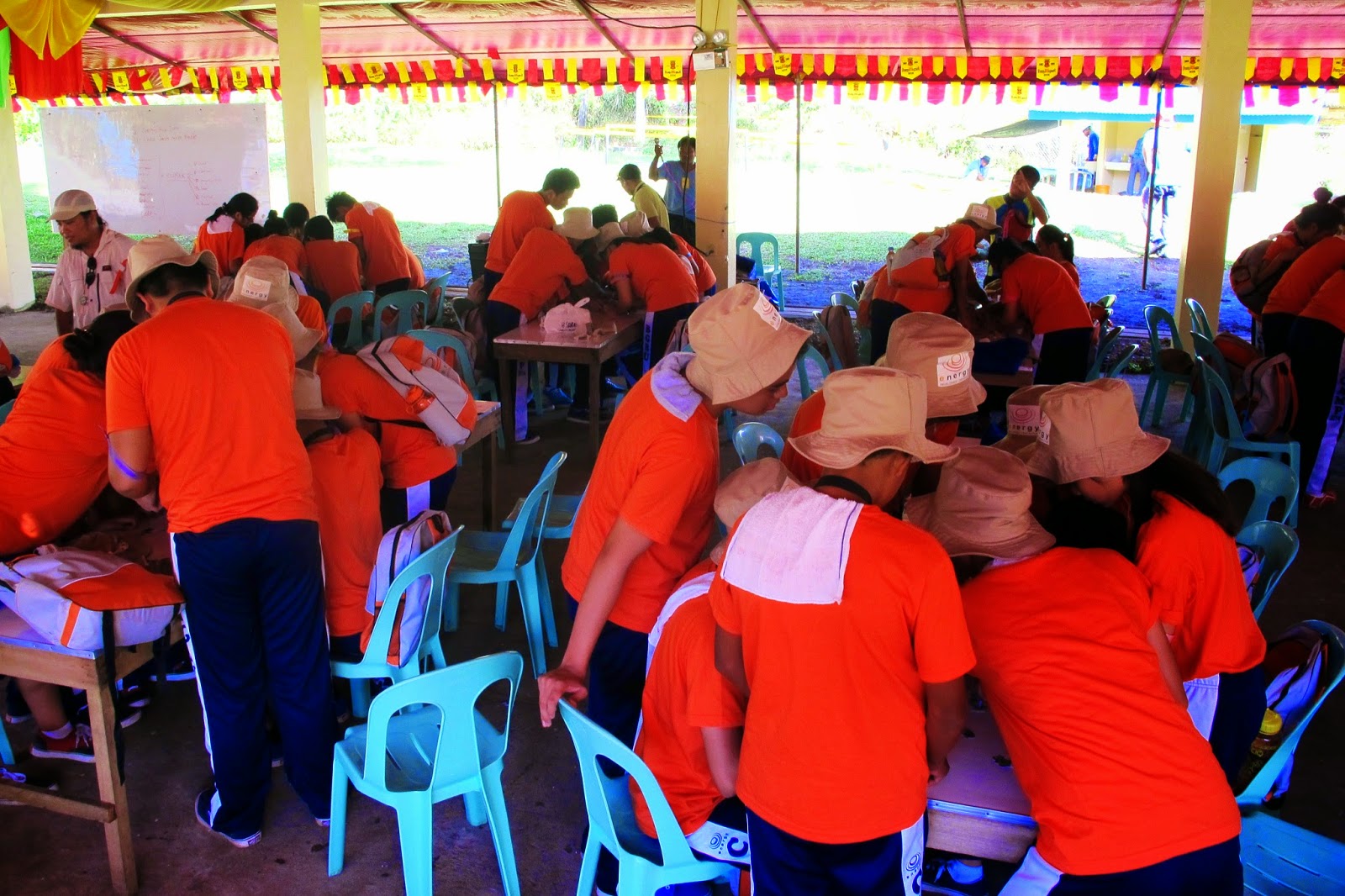 |
| Campers put their heads together to solve a puzzle during the Amazing Race challenge |
 |
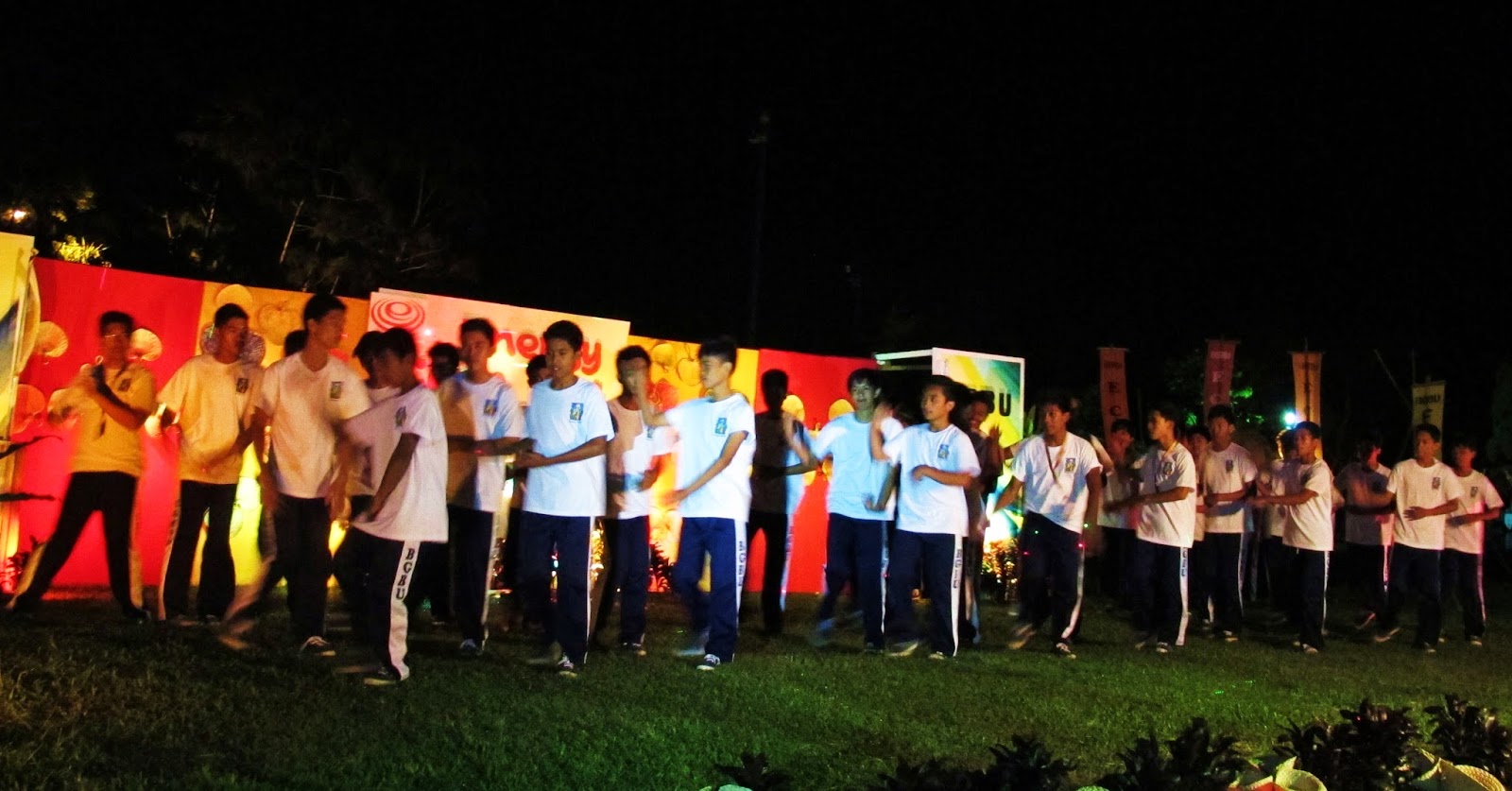
Campers perform during the closing ceremony of the Bacon-Manito Energy Camp
|

This year, two camps were held—in Bicol and Negros
Oriental—involving 112 participants. Because Leyte is still recovering from the
devastation of super typhoon Haiyan (Yolanda), an e-Camp was not held there
this year. The e-Camp in Mount Apo, North Cotabato, was discontinued a few
years ago because of difficulty in logistics. The BacMan e-Camp was held from
April 27 to May 2 with 66 campers, all high-school students. Fourteen were
children of EDC employees at the main office in Pasig City, while 25 were
children of employees of the Bacon-Manito Business Unit. Six campers came from
the Pantabangan and Masiway hydropower plants in Nueva Ecija, and 21 are
scholars from public schools in EDC’s host communities in Albay and Sorsogon.
There were more children of employees this year. The
number-one target of a CSR project is your employees, said Aquino. Still, the
e-Camp remains to be an excellent and exciting opportunity for learning and
gaining valuable experiences for deserving youths of the host community, who
most likely will not have access to this kind of activity because they live in
remote areas or are too poor to afford it if there is one available at all.
Campers are housed in comfortable bunkers at the
compound, which are really for guests and employees of the company. Mobile
phones and other gadgets are confiscated, and campers are not able to
communicate with family and friends for a week.
“Being part of this event was not very easy for all
of us. First of all, we were far from our home, family, friends and especially
Internet, gadgets. Second, we were all ordinary people in this camp. No
discrimination and special treatments. At first, I was afraid to join this kind
of camp,” revealed Christine Escudero, a 16-year-old student of Sorsogon
National High School. “But I learned many new things. I learned that there’s
beauty outside our home. There’s beauty behind those mountains and blue sky. I
met new people that have very unique talents and faces. I learned how to live
independently. I learned how to value life, to protect myself in times of
danger. I also discovered my talents...that I can be a good leader and also a
good follower.”
“Life is short. Every second counts. I believe that
I was able to experience the true meaning of these sayings through EDC's Energy
Camp,” recounted 17-year-old Clarisse Evaristo, daughter of an EDC employee
from Marikina City and a student of Assumption College in Antipolo City. “I was
being stubborn and lazy. I would rather lock myself in my room and spend almost
all of my time with my laptop, gadgets and television. I wanted to spend my
last summer before senior year relaxed and basically doing nothing.But come to
think of it, the idea was really absurd. I mean, why waste every single
precious second with mindless activities when you can spend your time enhancing
your skills and making an impact or positive change.”
This was further explained by Evaristo's fellow
camper, 16-year-old Charlie Dugan, an EDC scholar from the Osiao Paglingap High
School: “Masasabi kong napakahalaga ng summer camp na ito lalo na
para sa mga kabataang tulad ko. Dahil sa camp na ito, nagamit namin ang
oras at panahon sa isang kapakipakinabang at produktibong mgagawain. Naipakita
ko kung paano mapapahalagahan ang ating kalikasan.Natuto akong makisalamuha,
makibagay at makiisa sa anumang gawain.” (I can say this summer camp is
valuable for youths like me. Because of this camp, we spent our time in
practical and productive ways. I saw how to value nature.I learned how to get
along with others and cooperate in any tasks.)
“Before, I was a silent type of student with lots of
fear. But when I joined this camp, it was lessened little by little. Every day
and every single night in this camp was important and special for us because it
was another time to learn,” said Elline Ebio, a 16-year-old EDC scholar from
Osiao Paglingap High School.
“The success of the camp is gauged by the amount of
tears shed during graduation," Aquino has always been saying. He has
witnessed many tearful goodbyes of campers who had bonded for a week, living
together, sharing good food, undergoing activities together, experiencing new
things.
Another success of the camp, a more essential one,
was observed by Maria Yna Rose Garcia. The 16-year-old student of Sorsogon
National High School, who is this year's camper, had a brother and a sister who
attended the e-Camp before her.
“They were able to learn life skills and how to be
warriors of Mother Earth. They learned and at the same time had fun,” she
related. “They had changed. Something changed inside their hearts; they became
better persons.”
 |
| Sixty-six high-school students joined this year’s e-Camp in BacMan: 14 children of EDC employees at the main office in Pasig City; 25 children of employees of the Bacon-Manito Business Unit; six campers from the Pantabangan and Masiway hydropower plants in Nueva Ecija; and 21 scholars from public schools in EDC’s host communities in Albay and Sorsogon |


